
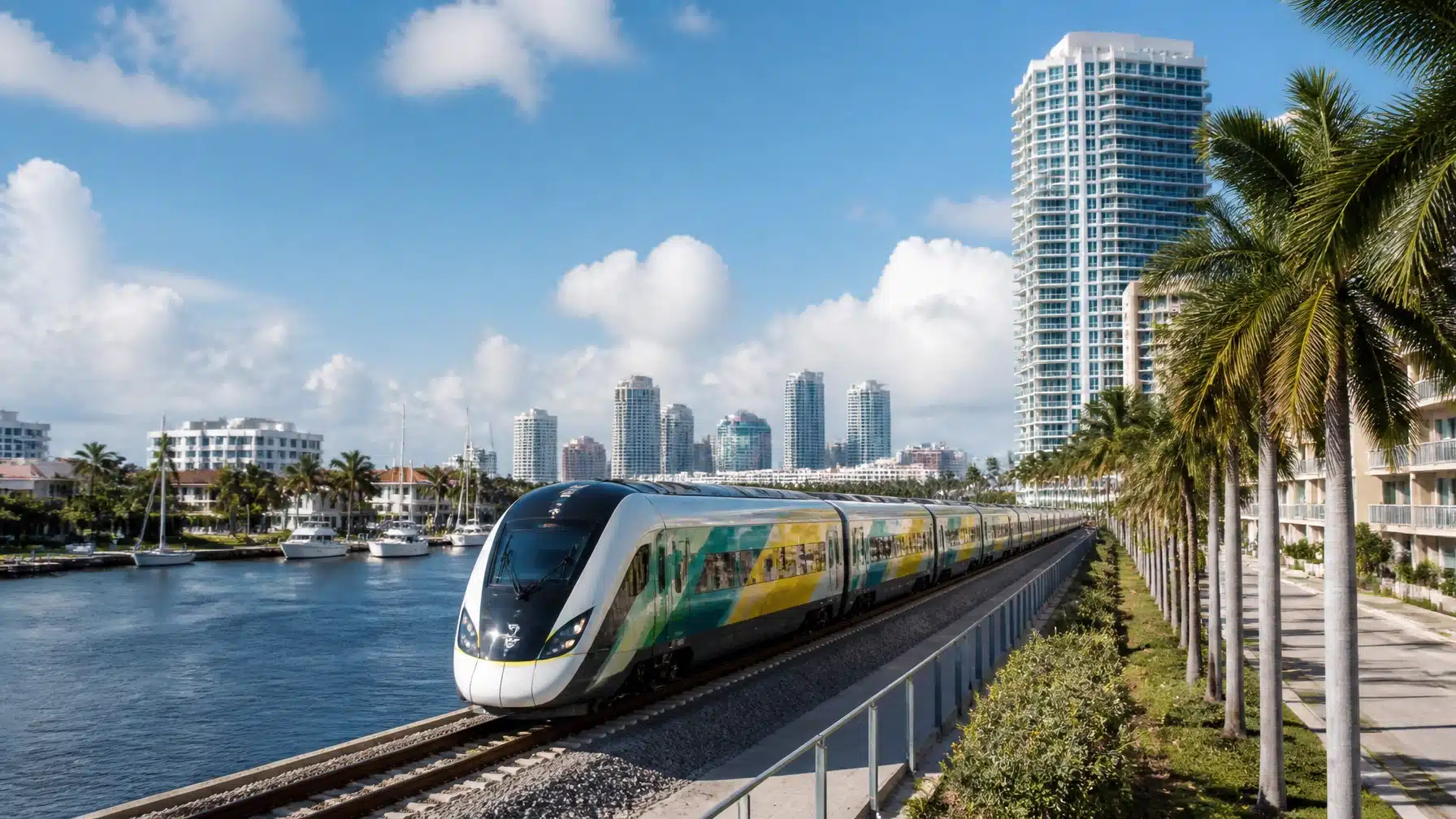

For decades, South Florida homebuyers often organized their search around one primary question: How close is the property to I-95?
That question still matters. Interstate 95 remains the backbone of daily travel between Palm Beach, Broward, and Miami-Dade counties. However, the region’s transportation map is changing. Brightline has made rail a practical option for more residents, workers, and visitors, while new transit-oriented developments are adding housing around major stations.
The result is a broader definition of convenience. A buyer may now consider living in West Palm Beach while working in Fort Lauderdale or Miami. A relocating household may be able to search a wider range of neighborhoods without accepting a daily drive through heavy traffic. Investors may also be watching station-adjacent areas for signs of sustained demand.
For anyone evaluating Fort Lauderdale real estate, Palm Beach real estate, or the broader South Florida real estate market, transportation access deserves a closer look.
Brightline Is Changing the Value of Distance
Brightline’s South Florida service connects West Palm Beach, Boca Raton, Fort Lauderdale, Aventura, and Miami. The train reaches Miami from West Palm Beach in approximately one to one and a half hours, depending on the schedule, and Orlando in about two hours.
That creates new options for people who do not want every trip to depend on a car. The effect is particularly relevant for professionals who divide their time between cities, households with different work locations, and buyers relocating from other states.
The ridership numbers indicate that the service is becoming part of everyday travel rather than remaining only a leisure option. Brightline reported more than 900,000 passengers in the first quarter of 2026, with average daily ridership nearing 10,000 passengers. Q1 revenue reached approximately $61 million. The company’s investor relations information provides ongoing updates about service and performance.
Brightline has also expanded multi-ride commuter products. The West Palm Beach–Fort Lauderdale corridor is among the routes covered by these options, with bundles generally structured around multiple trips. Pricing and availability can change, but the concept is important: regular rail travel is becoming easier to plan for commuters.
What does that mean for real estate? It means distance is increasingly measured in travel time and access, not only in miles.

Station-Area Homes Have Outperformed Their Broader Markets
Available housing data shows a notable difference between some station-area ZIP codes and their surrounding markets.
- Homes in the Fort Lauderdale ZIP code surrounding the Brightline station appreciated approximately 67% since the station opened in 2018.
- Over the same period, the median Broward-area increase was approximately 33%.
- In West Palm Beach, homes in the station-area ZIP rose about 37%, compared with approximately 30% for the wider area.
These figures do not establish that Brightline alone caused the appreciation. South Florida prices have also been influenced by population growth, employment, limited land, new development, and lifestyle demand. Still, the contrast suggests that proximity to a major transportation connection can support a neighborhood’s appeal.
The trend has also attracted developers. Properties near stations offer a combination that is increasingly valuable: shorter commutes, walkability, restaurants, employment access, and the possibility of living with fewer daily car trips.
That combination can create a premium. It can also make station-adjacent neighborhoods more expensive than nearby areas with similar homes but less convenient transportation.
West Palm Beach Is Seeing a Transit-Oriented Development Boom
Downtown West Palm Beach has become one of the clearest examples of this shift. Brightline proximity is reinforcing a broader financial and cultural revival, with new residential, hospitality, office, and retail projects reshaping the downtown core.
Several projects illustrate the scale of development:
Alida Residences
The Alida Residences and adjacent Marriott Tribute Hotel broke ground directly beside the Brightline station. The residential tower is planned at 21 stories with 181 units, while the hotel component adds hospitality and retail activity to the immediate area.
The project is designed for residents who value urban access and proximity to transportation. Its location makes it particularly relevant to professionals who may commute by rail or want to reach Miami and Fort Lauderdale without relying on I-95 for every trip.
The Berkeley Palm Beach
The Berkeley Palm Beach, located at 550 S Australian Avenue, is planned as a 25-story tower with 193 residences. Its development adds further density to the West Palm Beach corridor and reflects continuing confidence in downtown and near-downtown housing demand.
Elevated Agents recently covered these projects and other major construction activity in South Florida’s hottest new developments for 2026.
Fort Lauderdale and Flagler Village
Fort Lauderdale is experiencing a similar development pattern, particularly in Flagler Village and the surrounding downtown area. Recent projects include FAT Village, 745 N Andrews Avenue, Astor Park, and Edgewater Capital.
These developments are adding residential inventory near employment centers, restaurants, arts venues, and transit connections. For buyers considering Fort Lauderdale real estate, Flagler Village may offer a more urban lifestyle while remaining connected to the broader South Florida rail network.
A local development analyst quoted in Elevated Agents’ recent development review summarized the demand clearly: “Buyers want buildings that actively support their health and lifestyle.” In the current market, transportation is part of that lifestyle equation.
The New Commute: More Flexibility Between Cities
The traditional commute model assumes that a person chooses a home near their employer. That model is becoming less rigid for some South Florida households.
A buyer may work in Miami but prefer the residential environment, pricing, or community feel of West Palm Beach. Another may work in Fort Lauderdale while a partner works in Palm Beach County. With Brightline available, both people may have more flexibility in choosing where to live.
Rail will not replace the car for every household. Local errands, school transportation, client appointments, and work sites outside station areas may still require a vehicle. However, the ability to use rail for selected trips can reduce the pressure to live immediately beside an office.
It also expands the viable search area for people moving to Florida. Relocators are no longer limited to neighborhoods within a narrow driving radius if a station provides a reliable connection to work or family.

I-95 Still Matters, but Buyers Are Pricing in Congestion
I-95 remains essential. It connects the region’s major employment centers and provides access to communities that rail does not directly serve. For many buyers, highway access will continue to be a non-negotiable part of the search.
The issue is that congestion has become a more important factor in daily decision-making. A property that appears affordable may feel less attractive if the commute is unpredictable. Buyers are increasingly comparing not only purchase price and square footage, but also:
- Typical morning and evening travel times.
- Access to Brightline, Tri-Rail, or local transit.
- Distance from the station to the home.
- Walkability around the station.
- Parking and last-mile transportation.
- Whether the property supports a hybrid work schedule.
- The cost of maintaining a vehicle for every trip.
This is one reason transit corridors are drawing more attention. A walkable property near a station may command a premium, but it can also offer greater flexibility and a wider range of future buyers or renters.
What This Means for Buyers and Investors
Station-adjacent neighborhoods are among the faster-appreciating pockets in parts of South Florida. They may offer strong long-term potential, but they are not automatically a bargain.
Consider these factors before making a decision:
- Separate access from proximity. A property may be near a station by distance but difficult to reach on foot. Review sidewalks, crossings, shade, lighting, and the actual walking route.
- Compare the full commute. Include the time required to reach the station, wait for the train, travel, and complete the final segment. A door-to-door comparison is more useful than station-to-station time alone.
- Review development timelines. New towers, retail, and infrastructure can improve an area, but construction may create noise, traffic, and temporary inconvenience.
- Evaluate carrying costs. Condos near transit may have higher association fees, insurance costs, or newer-building premiums. Review the complete monthly budget.
- Consider future resale demand. A transit-friendly location may appeal to professionals, seasonal residents, investors, and relocators. That broader buyer pool can be valuable, although no investment outcome is guaranteed.
- Look beyond the station itself. Nearby neighborhoods may offer better value while still providing reasonable access. The right ZIP code may be one stop away rather than directly beside the station.
Miami-Dade’s proposed commuter rail agreement with Brightline could extend this pattern further. As of June 2026, the agreement remained under development and had not been finalized. The proposal would support commuter service between downtown Miami and Aventura, with additional stations along the corridor. If approved and implemented, it could increase the importance of transit access in more Miami-Dade neighborhoods.
Finding the Right South Florida Location
Transportation is becoming a central part of the South Florida home search. Brightline is changing how buyers think about West Palm Beach, Fort Lauderdale, and Miami. I-95 remains critical, but rail access is adding another layer to the decision.
For investors, station-area appreciation and new development deserve careful review. For relocators, transit access can expand the practical “sweet spot” of neighborhoods. For local buyers, it may provide more options when balancing work, lifestyle, and housing costs.
Elevated Agents helps buyers identify ZIP codes that align with both growth potential and daily lifestyle needs. Our team can compare station-adjacent neighborhoods, Flagler Village developments, West Palm Beach residences, and surrounding communities based on commute patterns, property type, budget, and long-term goals.
If you are exploring Florida relocation, researching a moving to Florida guide, or evaluating a Florida property investment, contact Elevated Agents for guidance on transit-connected opportunities across Greater Fort Lauderdale and Palm Beach County.
You can also reach the team at 561-810-3165 or info@elevatedagents.com.