
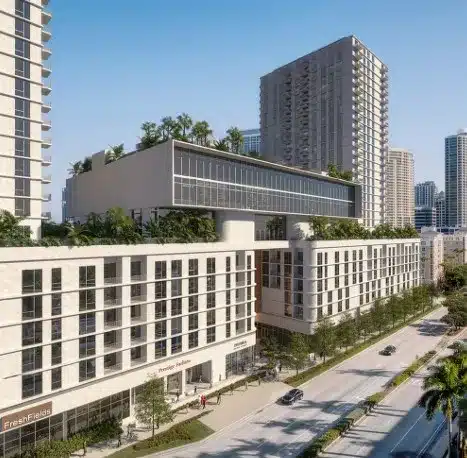

Cain International and Kushner Companies are planning a major rental development along Federal Highway in Fort Lauderdale.
Called Rio Vista Residences, the project would add 440 apartments, extensive health and fitness space, retail, restaurants, and 841 parking spaces just south of the New River. The proposal arrives while Fort Lauderdale’s apartment market is absorbing a large amount of new luxury supply.
That timing makes the project significant. It is not simply another development announcement. It provides a useful view into where institutional investors believe Fort Lauderdale can support long-term rental demand.
For renters, buyers, owners, and investors tracking Fort Lauderdale real estate, the project offers several practical signals.
The Rio Vista Residences proposal
Rio Vista Residences is planned for 633 S Federal Highway, in the Little River area just south of the New River. The site currently contains a two-story office building that is partly leased to law firm Conrad & Scherer.
The property is a 40,504-square-foot parcel, or approximately 1.1 acres. The buying entity, CI River District Phase 1 Owner LLC, is under contract to acquire the property from OKO Group. OKO Group purchased the site in June 2020 for $33.16 million.
The site sale has not yet closed.
The proposed development includes:
- Two residential towers of 28 and 22 stories.
- A nine-story connecting podium.
- Approximately 570,362 square feet of new construction.
- 440 rental units.
- Studios of approximately 565 square feet.
- Three-bedroom residences of approximately 1,625 square feet.
- More than 69,363 square feet of health and fitness space.
- Approximately 11,550 square feet of retail.
- More than 4,000 square feet of restaurant space.
- 841 parking spaces.
The project architect is Palma Architecture. Land use attorney Stephanie J. Toothaker of Toothaker & Thomas is handling the entitlement process.
The program points to a large, amenity-focused rental building. Residents would have access to wellness, retail, and dining uses without leaving the property. That live-work-play format has become increasingly common in new South Florida developments.

The project is still in the review process
The Fort Lauderdale Development Review Committee reviewed the plans on September 8, 2026. The review was an important step, but it was not final approval.
City staff requested revisions involving:
- Tower massing.
- Setbacks and the relationship between the towers and surrounding streets.
- Street-level access.
- Retail and restaurant visibility.
- Building materials.
- Parking ramp placement.
- Pedestrian circulation.
The proposal also includes deviations from the Downtown Master Plan involving building length, floorplate size, podium height, and street cross sections. Those deviations require approval from the Fort Lauderdale City Commission.
The South Florida Sun Sentinel reported that city staff described the current tower and podium configuration as bulky and overwhelming. Staff also encouraged stronger setbacks, more inviting storefronts, and higher-quality materials along the public-facing portions of the building.
No closing date, financing announcement, or construction start date has been disclosed. The project should therefore be viewed as an active proposal, not a project that is ready to break ground.
That distinction matters. Development plans can change during entitlement, financing, and design review.
This is Cain and Kushner’s second South Florida project
Rio Vista Residences is the second disclosed South Florida project from the Cain International and Kushner Companies joint venture since its launch in April 2026.
The partnership’s other announced project is a 364-unit tower in Miami’s Edgewater neighborhood. Rio Vista is different because it is the venture’s first disclosed ground-up rental tower rather than a condominium project.
That change in product type is worth watching.
Condos and apartments rely on different financial assumptions. A condominium developer generally depends on presales, deposits, and eventual unit closings. A rental developer must underwrite operating income, occupancy, rent growth, expenses, and long-term asset value.
The decision to pursue a rental project in Fort Lauderdale suggests the partners believe the location can support multifamily demand over a longer investment horizon.
As reported by The American Developer, the scale of the filing also indicates how much density institutional developers are willing to consider along Federal Highway south of downtown.
The timing is counterintuitive: rents are soft
The project is moving forward in a market that is not experiencing broad-based rent growth.
Fort Lauderdale’s apartment market is bifurcated. Luxury Class A properties are facing more competition, while workforce housing and well-located lower-cost rentals remain more resilient.
Depending on the data source and property segment, reported vacancy rates have ranged from approximately 7.6% to 9.7%. Around 8,760 units are tracked in the construction pipeline, with most of the supply concentrated in luxury properties.
Class A rent growth has largely stalled. One reported measure places annual growth near 0.1%.
New downtown towers and properties near the I-95 corridor are using concessions to attract tenants. These may include free rent, waived fees, parking incentives, or other move-in promotions.
The broader regional picture is also softer. Nearly 28,000 new units have been delivered across South Florida. In June 2026, the median asking rent in the Miami-Fort Lauderdale-West Palm Beach metropolitan area was $2,277, down 2.6% year over year, according to the regional rental data summarized in our South Florida rentals market update.
So why build now?
Developers are underwriting the long game
The answer is that institutional developers rarely underwrite a project based only on the current concession cycle.
A project of this scale may take several years to entitle, finance, construct, lease, and stabilize. Developers are making assumptions about where the market will be three, five, or more years from now.
Current rent softness is largely a supply story. New buildings are competing for tenants at the same time. That can create short-term pressure even when the underlying location remains attractive.
Fort Lauderdale continues to offer several long-term fundamentals:
- No state income tax.
- Continued migration from other states.
- Employment growth in and around downtown.
- Brightline connectivity to Miami, Boca Raton, and West Palm Beach.
- Limited developable land near the New River.
- Expanding dining, entertainment, and waterfront activity.
- Proximity to beaches, airports, highways, and regional employment centers.
The Rio Vista plan also reflects how developers are positioning new rental buildings. More than 69,000 square feet of health and fitness space is a substantial commitment. Retail and restaurant components add to the project’s daily-use appeal.
Residents are not only being offered an apartment. They are being offered a contained lifestyle environment.
That strategy may support leasing over time, but it also raises the project’s construction and operating requirements. The amenities must be delivered at a quality level that justifies the rents.

What the project means for renters
For renters, the current supply wave creates opportunities, but they are not evenly distributed.
Concessions are most common in new luxury buildings with a large number of comparable units. They are less common in suburban single-family rentals and workforce housing, where supply remains limited.
A renter comparing options should evaluate the effective cost of the entire lease:
- Add the full rent due over the lease term.
- Subtract verified concessions.
- Include parking, amenity, application, and technology fees.
- Review the renewal terms.
- Compare the effective rent with older buildings and private rentals nearby.
A free month may reduce the first-year cost. It does not necessarily mean the renewal rate will remain low.
The timing also matters. Winter demand can strengthen as seasonal residents return to South Florida. A renter who is flexible may find more leverage before the peak season, but a well-priced home can still attract competition.
Our earlier guide to South Florida rentals in 2026 provides additional guidance on concessions, lease terms, and the rent-before-you-buy strategy.
What it means for buyers and investors
For buyers and investors, Rio Vista provides a live development reference for the New River and Federal Highway corridor.
Institutional capital is showing that it is willing to underwrite a large multifamily project in this part of Fort Lauderdale, even with flat luxury rent growth. That does not guarantee future appreciation. It does indicate that major investors see long-term potential in the corridor.
Several factors deserve attention:
- The project’s eventual approval and construction timeline.
- The final tower design and amenity package.
- Future rental pricing and lease-up performance.
- Traffic and infrastructure improvements.
- Additional projects proposed nearby.
- The effect of Brightline and downtown employment growth.
- Whether new supply remains concentrated at the luxury level.
For a Florida property investment, development activity should be treated as one input rather than a guarantee. New construction can increase neighborhood appeal, but it can also create competition for existing rentals.
The same corridor may offer different opportunities for a long-term owner, a rental investor, and a primary-residence buyer.
What it means for nearby owners and sellers
Owners near the Federal Highway corridor should expect more competition from amenity-rich rental buildings if Rio Vista and other proposed projects are completed.
Older apartments and condominiums may need to compete on more than price. Condition, management, parking, outdoor space, renovations, and location will become more important.
For sellers, accurate positioning will matter. A property near new retail, restaurants, transit, and employment may benefit from neighborhood investment. At the same time, buyers may compare it directly with newer buildings offering gyms, pools, coworking areas, and on-site services.
This is particularly relevant for owners marketing luxury homes south Florida. The definition of luxury is increasingly tied to convenience, wellness, service, and building quality, not only square footage or water views.

The broader market signal
Rio Vista Residences does not prove that Fort Lauderdale’s rental market has already strengthened. The current data still shows elevated competition in luxury apartments and limited rent growth.
It does show that institutional developers are looking beyond the current cycle.
The project signals that Fort Lauderdale may continue to accept substantial density in strategic areas near downtown, the New River, and Federal Highway. It also reinforces the shift toward mixed-use buildings designed around on-site amenities and walkable daily services.
For residents, the near-term result may be more choices and more concessions in new luxury properties. For owners, it may mean stronger competition. For investors, the project provides a useful indicator of where major capital is placing long-term bets.
Development activity can change the trajectory of a neighborhood, but it does not eliminate the need for property-level analysis.
Elevated Agents helps buyers, sellers, renters, and investors understand development trends and neighborhood trajectories across Fort Lauderdale and Palm Beach County. To discuss South Florida real estate, rental options, or a potential Florida property investment, contact Elevated Agents at info@elevatedagents.com or 561-810-3165. Our team can help you evaluate how proposed projects may affect your next real estate decision.